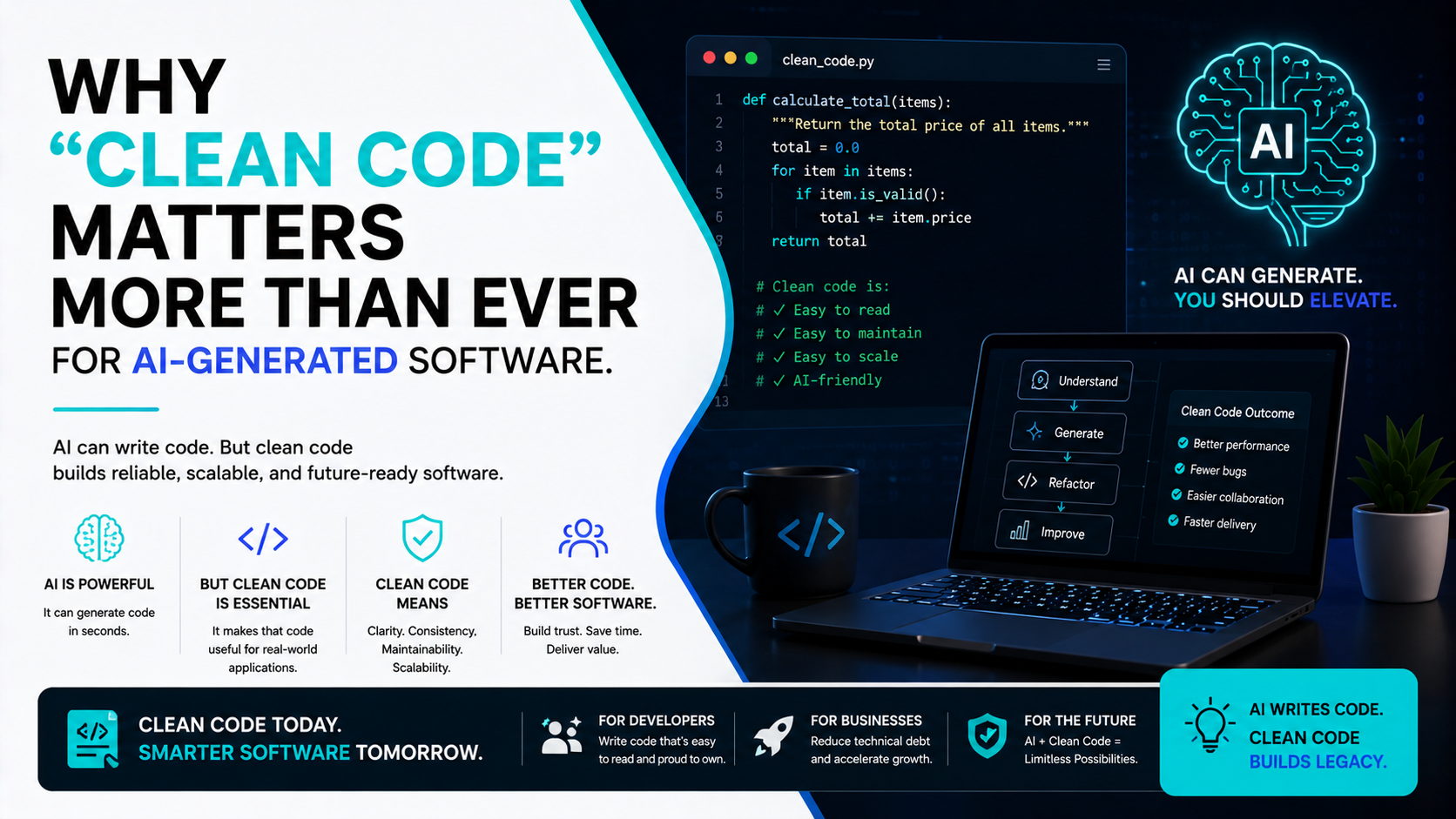
We live in an era where software generation happens at supersonic speeds. With the massive surge in large language models and intelligent developer platforms, generating hundreds of lines of complex application code takes mere seconds. Anyone with access to an internet browser can type a natural language sentence and instantly receive a functional backend script, a database controller, or a complete web interface.
But this sudden abundance of code introduces a quiet, critical challenge.
When software creation becomes effortless, systems scale too fast for human verification to keep up. Because artificial intelligence engines focus primarily on short-term execution rather than long-term architecture, they frequently emit unoptimized scripts, repetitive logic blocks, and hidden security vulnerabilities. For this exact reason, enforcing established clean code matters more than ever for AI-generated software. If engineering teams fail to audit these automated outputs, they risk drowning in uncontrollable software complexity.
The Core Illusion of Automated Code Generation
To understand the core problem, you must look closely at how modern AI coding tools function. An AI model does not think like a traditional software architect; it evaluates language probabilities. It analyzes thousands of open-source frameworks to predict the most likely structural sequence that fulfills your immediate text prompt.
The Working vs. Maintainable Paradox
The primary illusion of automated scripts is that they appear to function perfectly on the surface. You run the program, the interface boots up, and the unit tests pass successfully.
However, "working code" is entirely different from "maintainable code." While an AI can stitch together structural components to yield immediate operational results, it lacks the deep spatial awareness needed to ensure those components scale securely over several years. Without a human developer applying robust software engineering principles, an automated application quickly degrades into a tangled web of unreadable logic.
3 Hidden Vulnerabilities in Machine-Generated Repositories
When software engineering teams rely exclusively on machine generation without running comprehensive quality checks, they invite severe structural issues into their codebases.
1. The Sudden Explosion of Technical Debt Management Failure
Because generative software engines can produce infinite blocks of text instantly, developers often fall into a bad habit of copying and pasting huge files without refactoring AI code. This introduces redundant functions, bloated data arrays, and dead code pathways that have no real operational utility. Over time, this compounding lack of discipline makes the final application incredibly expensive and difficult to modify or update.
2. Lack of Contextual Software Architecture Integration
AI tools operate on a highly localized level. They look at the specific file or block of code you share in a single chat session. This isolated view means the model cannot comprehend how a localized script affects your overarching systemic infrastructure, global state variables, or external database pipelines. Consequently, pasting machine code often breaks subtle architectural patterns silently.
3. The Propagation of Subtle Security Vulnerabilities
AI models train heavily on public code repositories, many of which contain legacy formatting styles, deprecated libraries, and insecure data handling methods. If the training dataset contains an insecure pattern, the model will confidently replicate that vulnerability inside your modern corporate codebase, exposing your business to data liability risks.
Why Human-in-the-Loop Programming is Essential
The phrase "human-in-the-loop" describes an operational strategy where an experienced human engineer actively supervises, modifies, and approves every single component produced by automation. This hybrid approach turns a chaotic development sprint into a systematic engineering pipeline.
[The Automated Code Auditing Loop] │ ├── 1. Generate Raw Output via AI Assistant │ ├── 2. Human Audit: Apply Clean Code Principles │ ├── 3. Execute Refactoring AI Code Workflows │ └── 4. Validate Systemic Software Architecture Alignment
- Reading Code is the Ultimate Bottleneck: Studies show that developers spend up to 10 times more time reading, tracking, and debugging legacy applications than writing raw syntax from scratch. If the code generated by an AI tool is unreadable and messy, fixing bugs down the road becomes a nightmare.
- Enforcing Naming Conventions and Clarity: Clean code principles require every function, variable, and class object to possess a clear, descriptive name that declares its exact intent. If your machine-generated software uses vague variables like data1, tempval, or processStuff(), human developers will spend hours trying to decipher the system's true purpose.
Actionable Rules to Keep Your Machine-Generated Software Clean
If you use artificial intelligence tools to accelerate your development pipelines, you must implement a strict quality framework. Use the following guidelines to maintain clean repositories:
Enforce Strict Modular Code Separation
Never allow an AI engine to build massive, multi-thousand-line monolithic files that handle multiple tasks simultaneously. Force the model to break large applications down into small, isolated, single-purpose helper functions. This strategy makes the final architecture incredibly easy to test, read, and maintain.
Mandate Comprehensive Code Reviews
Treat machine-generated code with the exact same level of skepticism you would apply to a brand-new junior intern's work. Run every single output through an automated linting tool and conduct an manual peer review before merging any automated script into your main production branch.
Prioritize Architectural Design Thinking First
Before opening an AI coding assistant, sketch out your data schemas, infrastructure dependencies, and structural workflows on a whiteboard. When you possess a clear, human-designed blueprint, you can prompt the AI to build small, specific components that fit cleanly into your larger design rather than letting the machine guess the system architecture blindly.
Cultivating Advanced Technological Engineering Skills
As automated tools continue to reshape the global job market, the value of raw typing speed drops to zero. The developers who thrive in this new landscape are those who elevate their skills above simple syntax writing to master software design, database security, and system optimization.
Building this deep technical literacy requires a commitment to continuous learning. If you want to develop the analytical mindset needed to manage complex technological systems, explore the practical training pathways at the Milaaj Digital Academy. By understanding the underlying foundations of modern digital platforms, you learn to orchestrate advanced tech frameworks efficiently and securely.
Acquiring a deep understanding of software health ensures your projects remain highly competitive and scalable over the long term. Discover our specialized skill paths and engineering concepts directly on the main Milaaj Digital Academy Academic Portal to build the technical resilience required to lead the next generation of tech teams.
Frequently Asked Questions (FAQs)
Why does clean code matter more than ever for AI-generated software?
Clean code is vital because AI engines generate software at massive volumes without considering long-term sustainability. Without clean code standards like clear naming and modular structures, repositories become incredibly messy, making future updates almost impossible to execute.
Can AI tools write clean code automatically?
AI tools can write clean code if they receive highly detailed, well-structured prompts that specify exact formatting, modular restrictions, and naming rules. However, they still require a human engineer to audit the final script for hidden logical errors and architectural mismatches.
What is technical debt in the context of AI programming?
Technical debt occurs when a team uses fast, unoptimized machine-generated code blocks to deploy features quickly without refactoring. Over time, these messy layers of software accumulate, making the application fragile, slow, and expensive to manage.
How should junior developers use AI coding tools safely?
Junior developers should use AI tools as educational sidekicks rather than automated replacement engines. You should use AI assistants to explain complex error logs, suggest alternative algorithms, or write basic templates, while manually writing your core logic to build strong problem-solving skills.