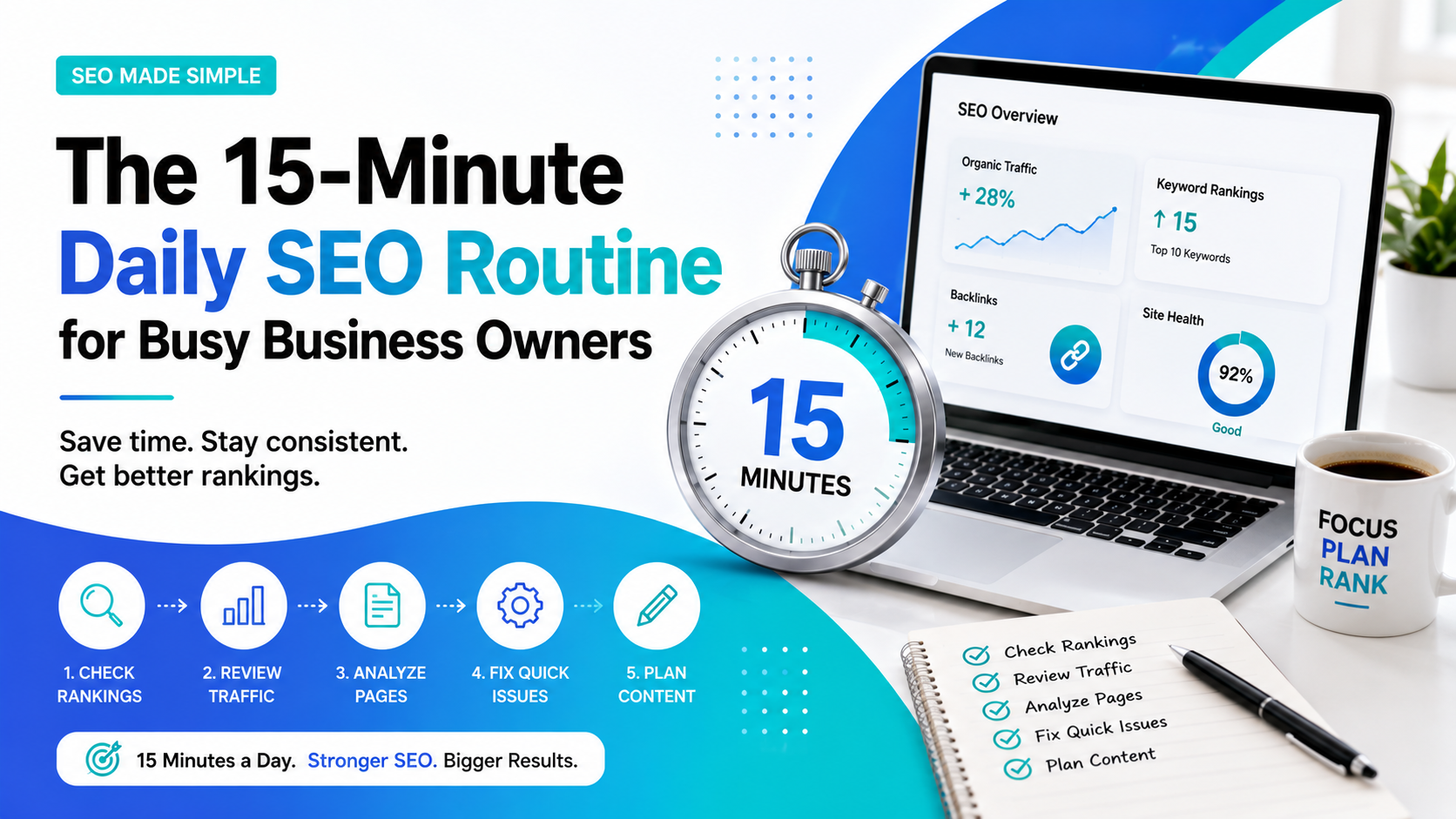
As a business owner, your day is a non-stop race. Between managing operations, handling customer requests, and chasing growth, your schedule leaves very little breathing room. When you hear the words "Search Engine Optimization," you probably picture endless hours of technical audits, complex keyword research, and frustrating code adjustments. It sounds like a full-time job—because it can be.
But here is a well-kept industry secret: consistency beats intensity every single time.
You do not need to spend eight hours a day on your website to dominate the search engine result pages (SERPs). By breaking down search optimization into tiny, actionable, bite-sized tasks, you can build an unstoppable digital asset. This definitive guide reveals the exact 15-minute daily SEO routine that busy business owners use to scale their organic visibility, protect their local rankings, and win more customers while saving time.
The Philosophy of Micro-SEO: Why Small Actions Compound
Before checking the clock, you need to change how you look at optimization. SEO is not a single mountain you climb once; it is a garden you water daily.
If you make a massive push once a year and then ignore your website for months, search engine algorithms will flag your domain as stagnant. However, when you complete a targeted, high-impact technical or creative action every morning, you send a continuous stream of "freshness signals" to search crawlers. Over a few months, these 15-minute sessions compound into massive gains in your topical authority and organic click-through rates.
Annual SEO Sprint: [Massive Effort Once] ──────> [Stagnation & Drop in Rankings]Micro-SEO Routine: [Daily 15-Minute Wins] ───> [Compounding Growth Curve]
1. The 15-Minute Weekly Rotation: Breaking Down the Daily Routine
To keep your workflow efficient and avoid burning out, do not try to fix everything at once. Divide your 15-minute daily SEO routine into a highly structured weekly rotation, dedicating each day to one critical pillar of organic search.
Monday: The 15-Minute Traffic & Rank Check (Analytical Day)
Start your business week by reviewing your performance metrics. This day is all about diagnosing issues and identifying unexpected traffic wins.
- Minutes 0-5: Open Google Search Console (GSC). Look specifically at your "Performance" report over the last 7 days. Identify any sudden drops in impressions or clicks, which could point to technical indexing bugs.
- Minutes 5-10: Check your targeted positions using automated keyword tracking tools. Look for "striking distance" keywords terms currently sitting on positions 11 through 15 (the top of page two). Highlighting these tells you exactly which pages need a small update to break onto page one.
- Minutes 10-15: Review your local search metrics. Look at your click-through rates and see how many local users requested directions or called your office.
Tuesday: Technical Health Clean-up (Fixing the Foundation)
Search engines will not recommend your pages if your technical foundation is broken. Use Tuesdays to clean up the backend of your site.
- Minutes 0-7: Run a quick automated crawl or check the "Indexing" tab in Google Search Console. Look for 404 error pages, redirect loops, or server communication failures that block search crawlers.
- Minutes 7-15: Focus on broken link tracking. Use a fast checker plugin to find and repair any broken internal or external hyperlinks. Fixing broken internal links instantly improves how easily crawlers navigate your site, which helps pass equity to your subpages.
- Mastering these quick analytical adjustments is the first major step toward taking complete ownership of your digital presence. Explore the core technical building blocks on our Milaaj Digital Academy Home Page, where we help leaders build high-performance business assets.
Wednesday: Local SEO & Google Business Profile Polish (Local Domination)
If your business relies on local customers, Wednesday is your most important 15-minute block of the week.
- Minutes 0-5: Log directly into your Google Business Profile (GBP) dashboard. Check for any pending user questions or new reviews.
- Minutes 5-10: Respond authentically to every new customer review—both positive and negative. Incorporate natural, hyper-local phrases into your responses (e.g., "Thank you for visiting our repair center in Al Barsha!"). This signals your geographic relevance to local proximity algorithms.
- Minutes 10-15: Publish a quick, high-quality business update directly to your Google Business Profile. Share a recent customer success story, post a clear picture of your latest project, or announce a weekly special.
Thursday: Content Optimization & Internal Linking (The Authority Booster)
You do not need to write a brand-new 2,000-word article every day. Instead, use Thursdays to boost the value of the pages you already have.
- Minutes 0-8: Take one of your "striking distance" pages identified on Monday and refresh its content. Add a new data point, answer a common user question directly beneath an H3 tag, or rewrite a weak meta description to improve your organic click-through rate.
- Minutes 8-15: Build strategic internal links. Find two or three older blog posts and link them directly to your newest service pages using natural, descriptive anchor text. This distributes link equity across your domain and guides users deeper into your site.
Friday: Competitor Analysis & Strategy Review (The Horizon Look)
Finish your week by checking what your competitors are doing in the search landscape.
- Minutes 0-7: Drop your top competitor's domain into a search analysis tool. Look at their recently published articles and updated service pages to see which topics they are trying to capture.
- Minutes 7-15: Brainstorm future topics based on your findings. Note down common customer questions you heard during the week and turn them into explicit, question-based headings for your next content update.
2. Setting Up Your 15-Minute SEO Command Center
To make this daily workflow run smoothly, you must remove all friction. Do not waste precious minutes looking for log-in details or trying to remember which tool to open. Build a dedicated, accessible browser bookmark folder containing your essential SEO tools:
- Google Search Console: For viewing indexation status, monitoring technical errors, and tracking organic impressions.
- Google Business Profile Manager: For managing local customer reviews and publishing instant updates.
- A Reliable Keyword Tracker: For monitoring your core target keywords and spotting position changes.
- A Fast Broken Link Checker: For keeping your internal link network clean and functional.
By keeping these platforms organized in a single folder, you can open your entire command center with a single click, allowing you to focus 100% of your energy on taking action.
Want to skip the trial-and-error phase and build an automated marketing workflow that saves you hours? Join our hands-on Advanced Digital Marketing Course at Milaaj Digital Academy to learn professional time-saving frameworks, advanced schema setups, and local search strategies.
Conclusion: Small Daily Wins Create Long-Term Growth
Search engine optimization can feel overwhelming when viewed as a massive, single task. But when you transform it into a highly focused, 15-minute daily SEO routine, it becomes an easy, sustainable habit. By spending just a quarter of an hour every morning reviewing your data, polishing local assets, and repairing internal links, you build a powerful digital presence that continually attracts high-value customers.
Stop waiting for a free weekend to fix your website. Open your dashboard, set a 15-minute timer, and claim your first search win today.
Frequently Asked Questions (FAQ)
Can a 15-minute daily SEO routine really improve my search rankings?
Yes, absolutely. Search engine algorithms favor websites that show consistent maintenance, steady internal link updates, and active user engagement over domains that receive sporadic updates. Small, daily optimizations send continuous freshness and activity signals to search crawlers.
What is the most critical tool for a busy business owner starting SEO?
The most important tool is Google Search Console (GSC). It is completely free and provides direct information straight from Google regarding your indexation status, real-time keyword impressions, mobile usability health, and technical server errors.
How often should I check for broken links on my website?
Checking for broken links once a week during your technical cleanup day is ideal. Fixing broken internal links immediately improves your site’s crawlability, helping search engine bots index your new content much faster.
Why is responding to Google Business Profile reviews considered part of SEO?
Responding to reviews is a powerful local search signal. When you include natural, geographic keywords and service terms in your replies, you help search algorithms understand your exact business category and service location, which boosts your visibility in local map packs.
Should I focus on writing new content or updating old pages during my daily routine?
If your time is limited, prioritize updating and optimizing your existing pages. Refreshing old content, adding clear answers to common questions, and building fresh internal links takes far less time than writing a new article from scratch, yet it delivers a rapid return on your organic search metrics.